Moving Cost Calculator
Move with confidence.


 Fact Checked by: Hilary Snow
Use moveBuddha’s free moving cost calculator to estimate how much your move will cost. You’ll get an instant moving estimate without putting in your email or other personal information. Plus, find helpful tips to save on your next move.
Your move is important to us because it’s important to you. We only recommend moving companies that are properly licensed and insured and meet our set of rigorous review standards. Read our full Moving Company Methodology. We take all reasonable measures to protect your personal data and maintain security. Read our Privacy Policy.In this post:
How much do movers cost?
On average, it costs $340 to $14,000+ to move, based on our 2025 cost data. We know that’s a wide range, but several factors go into moving costs. The biggest one is whether you choose a DIY move or a full-service one.
- Professional movers: Local moves typically cost between $455 and $3,000, while long-distance moves can range from $1,000 to $14,000+.
- Moving containers: Expect to pay between $400 and $700 for local moves, and $900 to $4,500 for long-distance container services.
- Rental trucks: Local truck rentals usually cost between $30 and $500, with pricing structures varying from company to company.
To get an accurate moving quote, always take these steps:
- Use a moving cost calculator to get an estimate tailored to your move details.
- Get multiple quotes from moving companies to compare pricing.
- Understand your needs: Know whether you need packing, unpacking, storage, or specialized services.
- Factor in additional costs like tolls, moving supplies, tips, and extra services.
Below are sample rates for local and long-distance moves based on different home sizes and distances.
Average cost of local moves
Full-service movers cost about $25–$100 per hour per moving crew member for local moves. According to our data, you’re more likely to pay around $270 per hour to move a two-bedroom home with three movers.
| Home Size | Avg. Total Cost | Cost/hour |
|---|---|---|
| Studio | $340 | $120 |
| 1 Bedroom | $460 | $120 |
| 2 Bedroom | $725 | $170 |
| 3 Bedroom | $1,625 | $235 |
| 4 Bedroom | $1,860 | $235 |
| 5+ Bedroom | $2,850 | $330 |
Average cost of movers by state
Moving costs vary by state, and so do your options for movers. Browse our best movers by state hub to compare companies where you live.
| State | Local move* ~50 miles | Interstate move ~500 miles |
|---|---|---|
| Alabama | $1,140 | $4,100 |
| Arizona | $660 | $3,970 |
| Arkansas | $650 | $4,050 |
| California | $995 | $3,950 |
| Colorado | $980 | $4,030 |
| Connecticut | $1,090 | $3,680 |
| Delaware | $1,220 | $3,810 |
| Florida | $960 | $3,500 |
| Georgia | $870 | $4,030 |
| Idaho | $860 | $4,660 |
| Illinois | $1,380 | $3,800 |
| Indiana | $1,120 | $3,960 |
| Iowa | $1,700 | $4,000 |
| Kansas | $890 | $4,120 |
| Kentucky | $740 | $4,070 |
| Louisiana | $1,220 | $3,960 |
| Maine | $1,180 | $4,660 |
| Maryland | $910 | $3,690 |
| Massachusetts | $1,010 | $3,880 |
| Michigan | $1,160 | $3,960 |
| Minnesota | $860 | $4,050 |
| Mississippi | $910 | $4,200 |
| Missouri | $1,000 | $3,920 |
| Montana | $1,050 | $4,660 |
| Nebraska | $910 | $4,000 |
| Nevada | $850 | $3,850 |
| New Hampshire | $1,570 | $4,470 |
| New Jersey | $1,090 | $3,690 |
| New Mexico | $660 | $4,310 |
| New York | $1,070 | $3,500 |
| North Carolina | $900 | $3,730 |
| North Dakota | $850 | $4,740 |
| Ohio | $950 | $4,080 |
| Oklahoma | $840 | $4,040 |
| Oregon | $1,020 | $4,470 |
| Pennsylvania | $1,050 | $3,810 |
| Rhode Island | $880 | $3,690 |
| South Carolina | $1,100 | $3,730 |
| South Dakota | $1,500 | $4,660 |
| Tennessee | $990 | $4,080 |
| Texas | $880 | $3,960 |
| Utah | $1,310 | $4,000 |
| Vermont | $1,780 | $4,470 |
| Virginia | $890 | $3,730 |
| Washington | $1,470 | $4,470 |
| West Virginia | $1,310 | $4,080 |
| Wisconsin | $1,170 | $4,040 |
| Wyoming | $880 | $4,660 |
Average cost of long-distance moves
Average long-distance moving costs can range from $1,000–$14,000+, depending on the size and distance of your move. For example, our data shows that moving a two- to three-bedroom home from New York City to Atlanta averages between $2,310 and $5,438.
| Mileage | Studio/1 Bedroom | 2–3 Bedrooms | 4 Bedrooms | 5+ Bedrooms |
|---|---|---|---|---|
| 150–250 miles | $1,165–$2,650 | $2,650–$4,385 | $2,860–$6,230 | $3,290–$7,165 |
| 250–500 miles | $1,380–$3,085 | $2,778–$4,669 | $3,088–$6,545 | $3,550–$7,525 |
| 500–1,000 miles | $1,845–$4,020 | $3,060–$5,280 | $3,580–$7,220 | $4,115–$8,305 |
| 1,000–1,500 miles | $2,200–$4,695 | $3,525–$5,955 | $4,305–$8,270 | $4,950–$9,510 |
| 1,500–2,500 miles | $2,335–$4,860 | $4,375–$6,750 | $5,500–$10,070 | $6,325–$11,580 |
Average cost of DIY moves
The average cost of a DIY move can vary depending on whether you book a moving container or rental truck, how much stuff you have to move, and how far you’re going.
Let’s look at the cost of moving containers and moving trucks.
- Moving container cost: The average cost to move within 50 miles with portable moving container companies is around $400–$700 for one container. For interstate moves, average moving container costs range from $900–$4,500 or more.
- Moving truck rental cost: The average price for a local moving truck rental ranges from $30–$500, depending on the size of the truck and duration of the rental. For instance, Budget Truck Rental charges $20–$60 per day (plus a per-mile fee) as their base rate for local moves.
Average city-to-city moving cost estimates
Based on moveBuddha’s proprietary 2025 moving cost data, here’s what you can expect to pay to move from different cities across the US. These ranges reflect accurate estimates for rental trucks, containers, and professional movers from our up-to-date cost guides.
Short-distance moves
| Route | Rental Truck | Moving Container | Full-Service Movers |
|---|---|---|---|
| New York City → Boston | $301 – $738 | $652 – $2,781 | $864 – $5,885 |
| Los Angeles → San Diego | $162 – $340 | $579 – $2,475 | $679 – $5,320 |
| Atlanta → Charlotte | $352 – $871 | $737 – $3,214 | $1,012 – $7,206 |
Medium-distance moves
| Route | Rental Truck | Moving Container | Full-Service Movers |
|---|---|---|---|
| Dallas → Denver | $695 – $1,903 | $897 – $4,353 | $1,397 – $9,415 |
| Chicago → Charlotte | $654 – $1,858 | $933 – $4,044 | $1,408 – $9,043 |
| New York City → Nashville | $755 – $2,067 | $955 – $4,352 | $1,329 – $8,828 |
Long-distance moves
| Route | Rental Truck | Moving Container | Full-Service Movers |
|---|---|---|---|
| Los Angeles → Dallas | $1,027 – $2,889 | $1,205 – $5,580 | $1,445 – $11,344 |
| Philadelphia → Austin | $1,219 – $3,506 | $1,219 – $6,497 | $1,470 – $11,486 |
| Seattle → Phoenix | $1,076 – $2,991 | $1,219 – $5,751 | $1,644 – $12,558 |
How are moving costs calculated?
Our free moving cost calculator considers the same factors that professional moving companies use to provide a quote, including:
- Move size: Larger moves are more expensive, as they require more labor and a larger moving truck.
- Distance: The greater the distance, the higher your moving quotes will be.
- DIY vs. professional movers: Moving containers or rental trucks are usually cheaper than professional movers, but you do the packing and heavy lifting.
- Time of year: Summer prices are higher because it’s peak moving season. The cheapest time to move is between October and April.
- Moving date: Moving prices are higher on weekends and at the beginning and end of the month.
Average moving cost by house size
Easily compare different moving costs by the size of your home with our full guides below:
Additional moving costs
Full-service movers may charge additional fees based on the details of your move:
- Specialty items: Pianos, pool tables, hot tubs, motorcycles, safes, and other bulky items will increase your cost.
- Packing supplies: Movers may charge extra if they use supplies like bubble wrap, mattress covers, or packing paper, or they’ll sell them to you directly.
- Additional services: You can pay a full-service mover for added services such as packing and unpacking and furniture assembly.
- Long-carry, stair-carry, shuttle, or elevator fees: If the mover can’t park within 100-150 feet of your door, has to use a smaller truck to get close, or navigate tricky staircases or elevators, they may charge fees.
- Storage: Many movers provide 30 days of free storage, with additional storage for a fee.
- Extra stops: Movers will typically charge a fee for additional stops beyond the primary residence.
- Expedited delivery: For an additional cost, movers will expedite your delivery and have your items delivered by a specific date.
How to lower your moving costs
There are a lot of ways to save money when moving. Here are some of our favorites:
- Sell, donate, or trash. The less you move, the less you’ll pay. Sell, donate, or trash anything that isn’t worth moving.
- Be flexible. Avoid moving around holidays, near the end of the month, or in the summer months. Having flexible moving dates can also result in a better price.
- Get multiple moving quotes. It’s not unusual for moving estimates to vary by thousands of dollars. Get at least three moving quotes for a fair price.
- Book early. When possible, book your mover 30 to 60 days in advance. Full-service movers may increase prices for last-minute bookings or have limited availability.
- Ask for price matching and discounts. Don’t hesitate to ask for a price match if you’ve found a cheaper quote elsewhere, or inquire about discounts.
- Get free packing supplies. Use our guide to find free moving boxes and other supplies.
- Use your insurance. See if your homeowners or renters insurance covers moving to avoid paying for full-valuation coverage.
How to use our moving cost calculator
By following these steps, you can easily plan and budget for your move. You’ll have moving quotes in less than 30 seconds, and since we don’t require any personal information, you won’t be bombarded with follow-up emails or calls.
Here are five simple steps to using our moving cost calculator:
- Select your origin and destination. In the “Where are you moving from?” and “Where are you moving to?” fields, enter the ZIP codes or city names you’re moving to and from.
- Choose your move size. Select the option that best describes the size of your move, from “A few items” up to a “5+ bedroom residence.”
- Pick your moving date. Use the dropdown calendar to lock in your anticipated moving date.
- Review your estimates. Once you enter the details above, the calculator will provide estimates for professional, container, freight, and rental truck moves.
- Compare your options. Review the estimated costs of each moving method, view services, and get quotes from different movers.
How a moving cost calculator can help you
Everyone should use a moving cost calculator before they start getting quotes from movers. It gives you a clear idea of what your move should cost and what types of services are available, like full service movers, containers, or truck rentals.
With this information upfront, you’ll avoid overpaying, asking the wrong questions, or choosing a service that doesn’t fit your needs. A calculator sets the baseline so you can compare quotes confidently and make smarter decisions from the start.
Here’s how a moving cost calculator can help you make your move smarter and less stressful:
- Compare moving methods: See estimated costs for full-service movers, containers, freight trailers, and rental trucks side by side.
- Estimate your budget quickly: Get solid moving quotes in seconds so you know what to expect before reaching out to movers.
- Understand what drives the price: See how factors like the size of your home, the distance of your move, and the services you choose can affect the cost.
- Avoid spam and sales calls: There’s no need to enter personal info to get moving quotes. You can get ballpark estimates here first.
- Choose the best moving company: Not sure which mover fits your situation? Our moving cost calculator can help you compare long distance movers and choose the right one.
- Make informed decisions faster: Get clear estimates without delays so you can start comparing options and planning your move right away.






moveBuddha helps 400,000+ people move every year, from cross-town to cross-country. Want to see how the calculator helped them? Read moveBuddha reviews.
Steps to get moving quotes
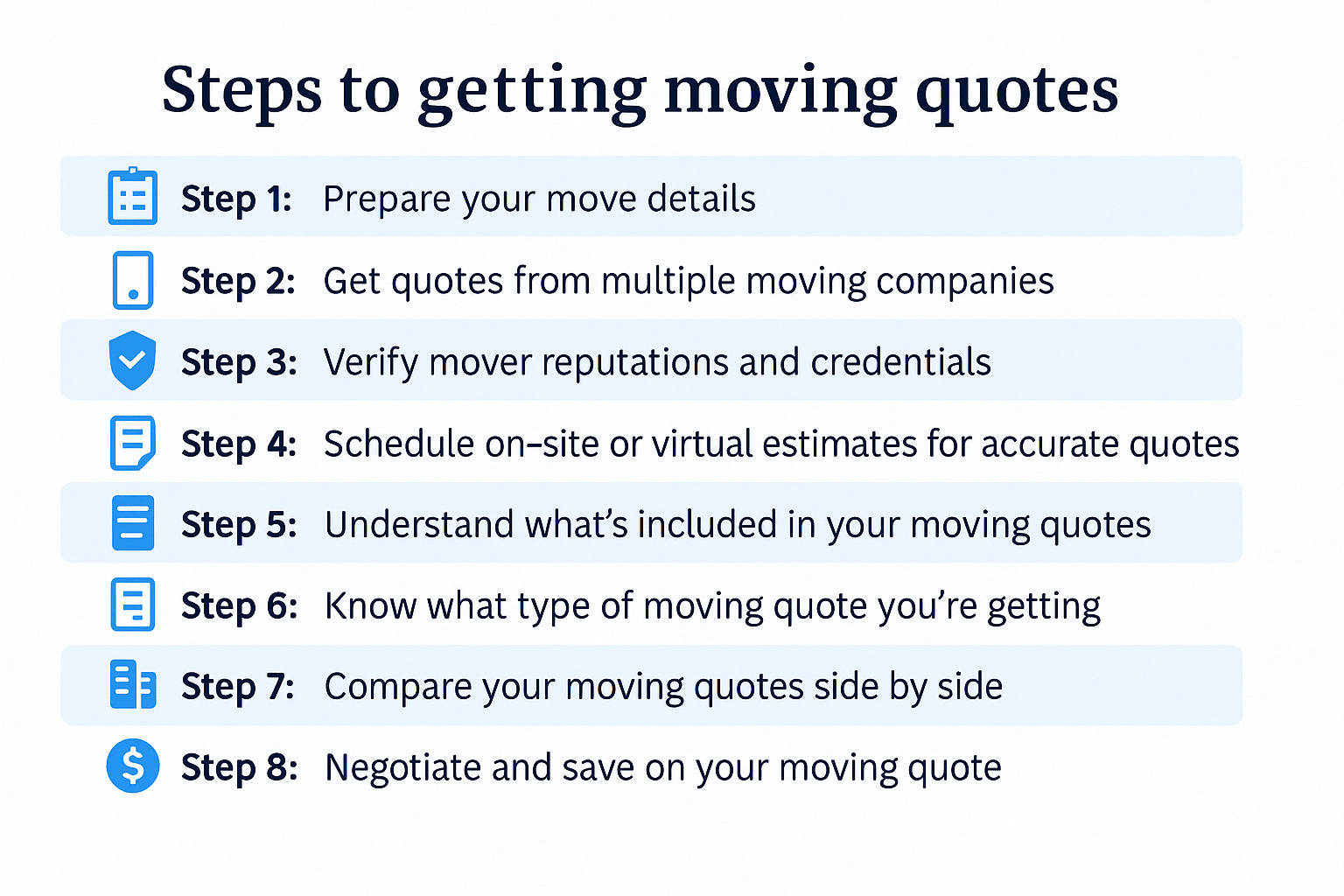
- Prepare your move details. Gather key info like inventory, move dates, locations, and any extra services to get accurate moving quotes.
- Get quotes from multiple moving companies. Compare at least three to five moving quotes to evaluate pricing and service options.
- Verify mover reputations and credentials. Check licensing, insurance, and reviews to avoid scams or poor service.
- Schedule on-site or virtual estimates. A walk-through—either in person or via video—helps ensure an accurate quote.
- Understand what’s included in your moving quotes. Review services, fees, move details, and insurance to avoid surprise charges.
- Know what type of quote you’re getting. Binding, non-binding, and not-to-exceed quotes each come with different rules.
- Compare quotes side by side. Look beyond the price to assess service levels, reputation, and potential red flags.
- Negotiate and look for savings. Ask about discounts, price matching, or other ways to reduce costs like DIY packing.
Should I hire movers or do it myself?
One of the biggest decisions you’ll make is whether to move yourself or hire professionals.
- Professional movers pack, load, transport, and unload everything for you. It’s more expensive, but it’s ideal for long-distance or full-service moves where time and convenience matter most.
- DIY moves with a rental truck or moving container are more affordable, but you’ll handle all the packing, heavy lifting, and logistics yourself.
Whichever route you choose, knowing how many boxes you’ll need is key to avoiding last-minute stress or overspending on supplies. Use our free moving box calculator to get a custom list based on your home size, how many people are packing, and your packing style.
FAQ
How far in advance should I book my move?
You should book your move at least six weeks in advance to get the best rates. Start researching options for your upcoming move around eight weeks in advance. Be sure to get quotes from at least three different movers to compare prices.
Should I try to move myself to save money?
You can certainly try to move by yourself if you want to save money. A DIY move can save you thousands of dollars in comparison to using full-service movers. Be aware that while you’ll save money, your move will cost you in terms of time and effort. If you’re not sure about doing all the work yourself, consider a moving container company. With moving container companies, you’re still responsible for packing and loading the container, but they will take care of the transportation.
What is the cheapest moving company?
The cheapest moving company depends on the type of move you choose. For DIY moves, renting a truck with U-Haul is one of the cheapest options. For moving containers, U-Pack offers the best prices and quick, transparent quoting. If you’re looking for a full-service mover, North American Van Lines and Mayzlin Relocation are among the most affordable options. Don’t just look for the absolute lowest rate you can find — make sure a cheap moving company also has a solid industry reputation.
Do moving quotes include car shipping?
No, moving quotes do not include car shipping. Not all moving companies provide car shipping services. If you have to ship your vehicle, you’ll typically need to get separate quotes from car shipping companies. Our car shipping cost calculator can give you a better idea of how this will affect your overall moving budget.
| Distance | Open trailer | Enclosed trailer | Average cost |
|---|---|---|---|
| <500 miles | $605 | $935 | $760 |
| 500-1,000 miles | $915 | $1,155 | $1,005 |
| 1,000-1,500 miles | $1,190 | $1,715 | $1,315 |
| 1,500-2,500 miles | $1,505 | $2,020 | $1,710 |
| 2,500+ miles | $1,700 | $2,305 | $2,005 |
Is the moveBuddha moving cost calculator reliable?
Yes, the moveBuddha moving cost calculator is reliable. It is designed to capture relevant details about your move and transform these inputs into a reliable cost range. Its accuracy and dependability are a result of years of refinement based on real-world data and moving cost trends. While your actual moving expenses may vary, this cost range should give you a good idea of what to expect so you can budget appropriately for your move.
Why should I trust moveBuddha’s moving quotes?
You should trust moveBuddha’s moving quotes because they’re the product of our years of experience and extensive knowledge of the moving industry. MoveBuddha has helped people move since 2015, serving more than 400,000 people per year. Our moving quote tool combines our tech focus with deep-dive analysis of hundreds of companies using our own unique methodology.
We rely on quotes obtained through our secret shopping process and the real-life, honest experiences of Better Moves Project participants to help provide a range of what you should expect to pay based on the details of your move.
How much does it cost to have a moving company pack you?
On average, it costs $900 to $1,500 to have a moving company pack you. Packing costs are calculated based on the size of the move. For example, full packing services for a one-bedroom apartment will range from $250 to $500 while the cost of packing for a three-bedroom home will range from $1,000 to $1,800. Fragile, specialty, and bulky items like expensive art or a safe can significantly increase packing costs. One major benefit of having a mover pack all your items is insurance. If the mover packs the boxes for you, then they will be liable for any damages resulting from improper packing.
Can you negotiate your moving costs?
Yes, you can definitely negotiate with moving companies. They usually have moving discounts or other options to lower your quote. You can also bring quotes you’ve received from competitors to see if they’ll outbid other companies or offer price matching. Ask your sales rep for advice on further reducing your costs. For example, being flexible with your move dates or ditching high-cost items like pool tables or heavy safes can help reduce overall moving expenses.
moveBuddha’s Moving Pricing Methodology
Our calculator runs on one of the most comprehensive and current pricing datasets in the moving industry. It’s updated monthly with 1,000+ new data points from across the United States.
We source real-time rates through automated feeds and APIs, our Better Moves Project, direct quote requests, and anonymized user quotes from this very tool. Our dataset covers everything from full-service movers to containers, truck rentals, and moving labor. This approach means you can compare apples to apples.
Because our inputs update continuously, our cost averages reflect real-world conditions like fuel prices, labor availability, carrier capacity, seasonality, and active promotions. Rates adjust within weeks as the market shifts.
To keep results accurate and fair, we use median-based lane summaries, stratified sampling by service type, region, and move size, plus outlier detection and provider verification. We’re also transparent about what’s included.
After more than a decade of price tracking, our data has been cited by universities, hedge funds, and major outlets like The New York Times, Bloomberg, and USA Today. You get friendly advice backed by serious rigor.
Our track record





Each year, 400,000+ people trust our moving recommendations. Here are a few reasons why:
- Founded in 2015
- 3,500+ moving companies analyzed
- $50,000 in moving grants delivered
- Up-to-date pricing info & industry data
- Fact-checked for accuracy
How we chose the best moving companies
The moveBuddha team has spent nearly 10 years evaluating moving companies using a rigorous review system to identify the best moving companies. Our thorough methodology evaluates each moving company's services, cost, customer service, and reputation:
Moving services (35%):
We verify operating authority, insurance, and service scope against FMCSA/SAFER and state databases. We confirm availability via standardized mystery-shopping calls (packing tiers, storage type, specialty handling, delivery windows, valuation), and then review contracts alongside complaint and claims patterns over time.
Customer feedback (28%):
We run structured post-move surveys through our Better Moves Project with verifiable documentation. We emphasize on-time performance, care of goods, and estimates’ accuracy, and we investigate outliers before they influence scores.
Online reviews (7%):
We aggregate ratings across multiple third-party sites to reduce platform bias, analyze overall trends and company response behavior, and discount obvious spam/fake signals such as sudden bursts, duplicate language, and low-history profiles.
State availability (12%):
We confirm USDOT numbers, broker vs. carrier status, and any required state permits, then score a state-by-state service matrix that accounts for coverage gaps, seasonal limits, and lane strength. We award additional credit for documented cross-border or specialty lanes.
Additional services (12%):
We verify whether add-ons are performed in-house or subcontracted, look for crew training/certifications for high-value or oversized items, count only documented offerings (tariffs, photos, written service descriptions) confirmed via mystery shopping, and reward robust pre-move planning (virtual surveys, itemized crating).
Quotes/Payment options (6%):
We test standardized move profiles to assess estimate type (binding, not-to-exceed, non-binding), line-item transparency, and disclosed surcharges, require clear written policies for deposits, refunds, and cancellations, and award points for secure, flexible payment methods and customer portals.