The Cheapest Way To Ship Moving Boxes
Here’s the quick answer: The cheapest way to ship moving boxes is USPS when you only have a few, with Priority Mail Flat Rate boxes costing $13.66 – $34.02 to anywhere in the U.S. For heavier loads, freight or one of the best moving container companies usually costs less per box. If you’re already driving to your new home, a U-Haul trailer from $14.95 per day often beats them all.
Jump to the box shipping info you’re looking for:
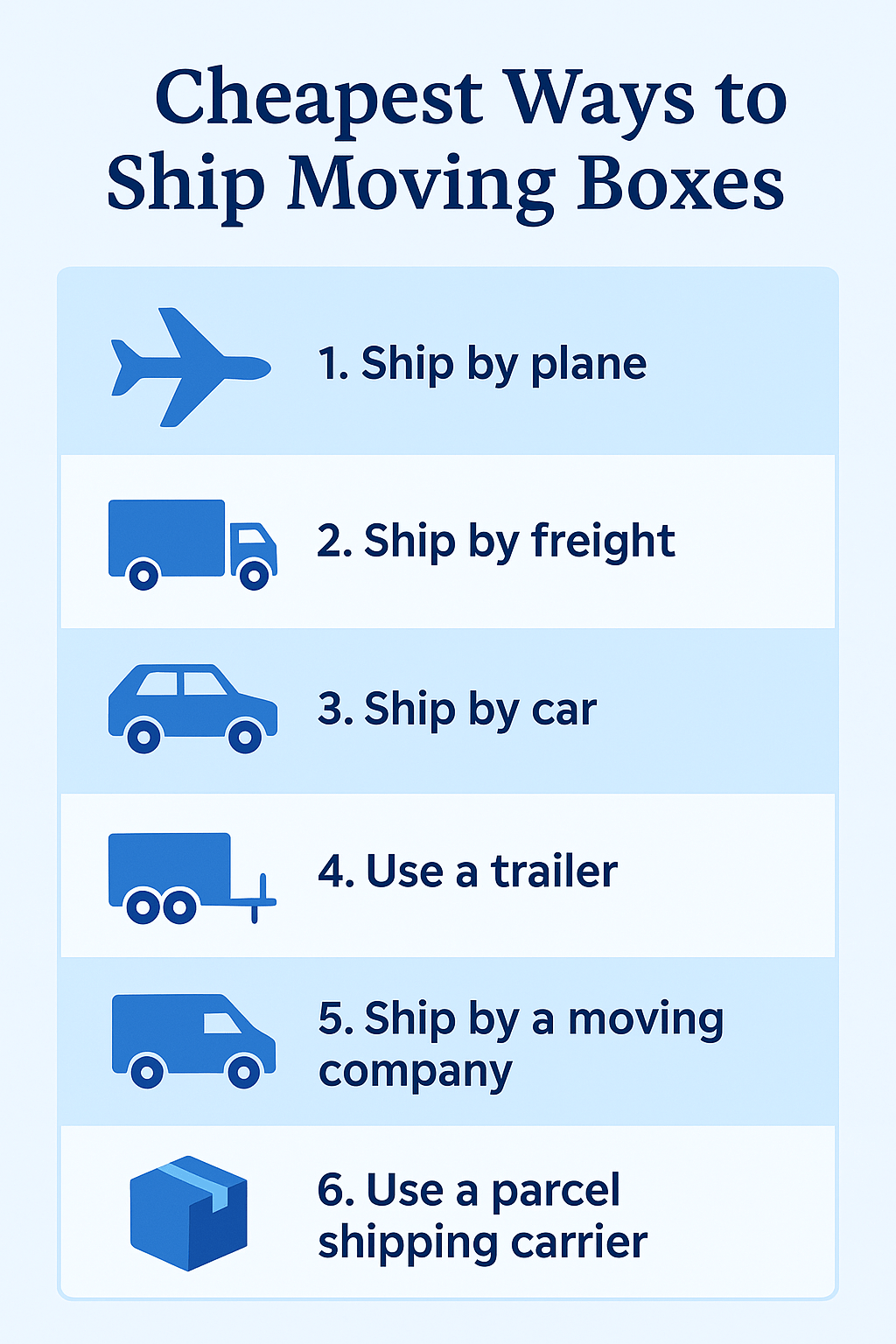
6 cheapest ways to ship moving boxes
The cheapest way to ship moving boxes depends on how many boxes you have, how heavy they are, and how far they’re going. Here’s how the six options compare on cost and delivery time as of 2026.
| Method | Est. cost | Delivery | Best for |
|---|---|---|---|
| Plane | $45 – $200 per bag | Same day | A few boxes of essentials |
| Freight | $50 – $500+ | 3 – 14 days | Heavy loads short of a truck |
| Car shipper | Free up to 100 pounds* | 7 – 14 days | Boxes in a car you’re shipping |
| Trailer | $14.95+ per day & gas | You set it | Drivers who can tow |
| Moving company | $550 – $8,000+ | 1 – 14 days | Big or fragile loads |
| Parcel carrier | $12 – $40+ per box | 1 – 8 days | A few durable boxes |
*Allowances vary by car shipper.
1. Ship by plane
Checking boxes as luggage costs $45 – $50 for the first bag on most major U.S. airlines as of 2026. It works best for a few boxes of essentials you want waiting for you the day you land.
- First checked bag: Southwest and Alaska charge $45, while Delta, United, and American charge $45 prepaid or $50 at the airport.
- Second checked bag: Expect to pay $55 – $60, depending on the airline and whether you prepay.
- Third checked bag: Southwest charges $150, and Delta, United, Alaska, and American charge $200.
Our take: Most airlines cap checked bags at 50 pounds and 62 linear inches, so this method doesn’t suit heavy or bulky boxes. We also wouldn’t check anything fragile.
Pros & cons
- Boxes arrive when you do
- Nothing extra to book
- Affordable for 1 – 2 boxes
- 50-pound limit per bag
- Risky for fragile items
2. Ship by freight
Freight companies ship your boxes in unused space on trucks already running your route, which keeps the cost per box low. Expect to pay $50 – $500+, and you can often negotiate.
- Cost: Rates depend on weight, distance, and how much space your shipment takes on the truck.
- Timing: Delivery follows the driver’s existing route, so you may not get a guaranteed delivery date.
- Booking: Marketplaces like uShip let carriers bid on your shipment, but service quality varies by carrier.
Our take: Freight is a smart pick when you have too much for parcel shipping but not enough to justify a moving truck. It also handles pallets of boxes and bulky items well.
Pros & cons
- Handles heavy & bulky items
- Negotiable rates
- Low cost per box on big loads
- No guaranteed delivery date
- More legwork to book
3. Ship with your car
If you’re already shipping your car, some auto transporters let you pack boxes in the trunk at no added cost. Sherpa Auto Transport and SGT Auto Transport both allow up to 100 pounds of personal items in the trunk or cargo area.
Our take: This option works best for a few boxes of non-essentials like linens. Confirm the policy in writing, since many carriers don’t allow personal items at all, and SGT doesn’t allow them on shipments to or from Hawaii. Compare the best car shipping companies to find one that does.
Pros & cons
- Up to 100 pounds free with some shippers
- No separate shipment to book
- Boxes ride along in your car
- Not all carriers allow personal items
- Slower 7 – 14 day delivery






4. Tow a trailer
Towing a trailer behind your own vehicle adds little to a move you’re already driving. U-Haul utility trailers start at $14.95 per day and enclosed cargo trailers at $19.95 per day for in-town rentals, and every U-Haul cargo trailer can be rented one-way.
If you’ll tow often, a used trailer from Facebook Marketplace or Craigslist may pay for itself.
Our take: Only tow a trailer if you’ve done it before. You’ll need to know your vehicle’s towing capacity, how to hitch safely, and how a loaded trailer handles.
Pros & cons
- Full control over timing
- Boxes stay with you
- One-way cargo trailer rentals
- Requires towing experience
- Adds to your fuel costs
5. Hire a moving company
Hiring movers isn’t the cheapest way to ship a few boxes, but it makes sense when you have many heavy boxes or furniture going too. Expect $550 – $8,000+, and note that many of the best interstate moving companies set minimum shipment sizes.
moveBuddha’s moving cost calculator weighs distance, home size, move date, and service level together, so the range you see reflects your move rather than a flat average.
Our take: Choose a moving company for a hands-off move with professional packing, loading, and transport. It’s the safest route for fragile or high-value boxes.
Pros & cons
- Pros handle packing & loading
- Safest for fragile items
- Moves furniture too
- Highest cost per box
- Minimum shipment sizes




 rating

 4.23 / 5


- Specialty packing services
- White-glove reputation
- 80+ years' experience
6. Use a parcel carrier
USPS, UPS, and FedEx are the cheapest way to ship a few moving boxes, with door-to-door delivery and tracking. USPS is usually cheapest for lighter boxes, while UPS often wins on boxes over 10 – 15 pounds going long distances.
- USPS Flat Rate: Priority Mail Flat Rate boxes cost $13.66 – $34.02 as of 2026 and ship anywhere in the U.S. for one price, up to 70 pounds.
- USPS Ground Advantage: A 10-pound box costs about $12 – $25 depending on distance, and a 20-pound box costs about $40 to the farthest zones.
- UPS and FedEx: Both accept boxes up to 150 pounds, so they’re the better fit for heavy boxes USPS won’t take.
- USPS Media Mail: Books ship for as little as $4.13 for the first pound, though delivery takes 2 – 8 business days.
Our take: Parcel carriers suit a small number of durable boxes like books, clothing, and kitchenware. Costs add up fast past 20 pounds per box, so weigh your boxes and compare rates on the USPS site before you ship.
Pros & cons
- Door-to-door delivery & tracking
- Cheap Media Mail rates for books
- Flat Rate boxes from $13.66
- Costs climb fast on heavy boxes
- Risky for fragile items
Why moveBuddha:
- On average, moveBuddha users save more than 30% by comparing movers before booking.
- When you choose a moveBuddha Certified mover, you get $1,000 in added move coverage, plus dedicated support throughout your move.
- If something goes wrong, moveBuddha provides dispute mediation with Certified movers to help resolve the issue and protect your move.
Who ships moving boxes?
Moving containers and small-move specialists fill the gap between a few parcels and a full moving truck. On average, moving containers cost about 30% less than full-service movers.
U-Pack ReloCube
U-Pack ReloCube is our top pick for the cheapest moving containers on value. One ReloCube holds about one large room, which makes it a fit for studio and one-bedroom moves.
Cost
U-Pack isn’t always the lowest bid, but its rates include the driver and fuel, so there are no surprise transport fees.
How it works
- Loading: You pack and load the ReloCube, and U-Pack handles the transport.
- Security: You lock the cube and keep the key for the whole move.
- Flexible count: Reserve as many cubes as you think you’ll need and only pay for the ones you use.
Our take: ReloCube won’t always be the bottom-dollar option for shipping boxes, but it’s a strong value if you want a fixed, all-in transport rate.
 rating
5 / 5
rating
5 / 5
U-Haul U-Box
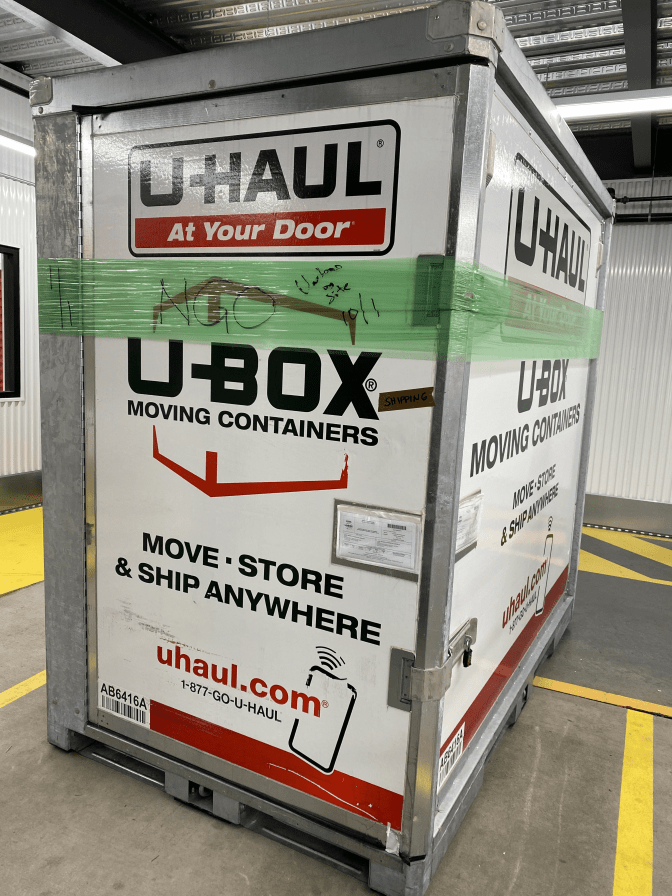
U-Haul U-Box is a strong option if you need to store your boxes before delivery. One U-Box holds about 1.5 rooms of household items, and U-Haul ships containers locally, across the country, or internationally.
Cost
You’ll pay less if you load and unload at a U-Haul facility instead of choosing door-to-door delivery. We estimate a two-bedroom’s worth of boxes costs about $1,368 to ship under 50 miles and about $4,230 long-distance.
How it works
- No change fees: U-Haul doesn’t charge to change your date or cancel your reservation.
- Capacity: About 1.5 rooms of belongings fits in a U-Box.
- Flexible count: You only pay for the containers you use, even if you order extras.
- Delivery options: U-Haul can ship your containers, you can tow them yourself, or you can load them at a U-Haul location.
Our take: U-Box suits movers who want a well-known brand and live near a U-Haul facility. Order an extra container if you’re unsure, since U-Haul takes back the ones you don’t use.
 rating
4.15 / 5
rating
4.15 / 5
uShip
uShip is an online marketplace where freight carriers bid on your shipment, which can bring the cost of shipping moving boxes well below a dedicated truck. You compare bids, timelines, and services side by side before you book.
Cost
uShip prices vary because carriers set their own bids, so you can pick the one that best fits your budget.
How it works
- List your shipment: Enter your pickup, delivery, and shipment details.
- Collect bids: Available carriers bid with expected timelines and the services they offer.
- Book: Review the offers and book the carrier you want.
Our take: uShip works if you can wait for bids to come in. It’s not the right fit if you need a company that can guarantee service quality.
 rating
3.9 / 5
rating
3.9 / 5
Ship Smart
Ship Smart handles small cross-country moves nationwide and is one of our picks for the best small-load companies, thanks in part to its white-glove services.
Cost
Ship Smart’s prices are competitive, and moveBuddha readers get a 10% discount. Call (866) 333-8018 and mention moveBuddha to claim it.
How it works
- Shipment size: Ship Smart moves loads up to 2,000 pounds with no weight minimum.
- Packing: Professional packing is included with every shipment.
- Coverage: Full replacement insurance is available, with deductibles starting at $100.
Our take: Ship Smart fits movers who want more help than a self-service option but don’t want to pay for a full-service mover.
 rating
4.2 / 5
rating
4.2 / 5
MiniMoves
MiniMoves fills the gap between full-service movers and small moves that don’t meet their minimums. It has handled small state-to-state shipments since 1991 and doesn’t require a minimum load.
Cost
Prices vary by shipment, but you can get a ballpark estimate online without talking to anyone. A binding quote requires your inventory details.
How it works
- Partner network: MiniMoves completes moves through a network of partner carriers.
- Door to door: Pricing covers pickup, transport, and delivery.
- Add-ons: You can add packing and unpacking for an extra charge.
Our take: MiniMoves is a good choice for a few boxes or small furniture going to a studio or one-bedroom. It’s a weaker fit if you want a guaranteed in-house crew.
How to ship moving boxes
A little planning keeps your boxes on budget and in one piece. Follow these steps:
- Compare quotes. Price at least two methods from this guide, since the cheapest option for five boxes is rarely the cheapest for 50.
- Check size & weight limits. USPS caps packages at 70 pounds and UPS and FedEx at 150 pounds, so weigh boxes with a luggage scale as you pack.
- Gather sturdy supplies. Use heavy-duty corrugated boxes in several sizes and the right packing supplies. moveBuddha’s packing and moving box calculator estimates how many boxes of each size you need.
- Pack tightly. Fill gaps so items can’t shift, and pack breakables with extra padding. Professional packing through a service like HireAHelper or a mover adds about $0.15 – $0.21 per pound.
- Label every box. Print clear shipping labels and mark “fragile” or “this side up” where needed to avoid delays and misdeliveries.
- Confirm coverage & dates. Get tracking numbers, delivery dates, and fees in writing, and check whether your shipper or renters insurance covers high-value items.
Pro tip: Skip buying new boxes for durable items. Liquor stores, grocery stores, and local buy-nothing groups often give them away, and our guide to free moving boxes lists more sources.
Choosing the cheapest option
For a few light boxes, USPS is the cheapest way to ship moving boxes, and Media Mail is cheapest for books. If you’re flying or shipping a car anyway, checked bags or your trunk can carry a few more.
For heavier loads, compare uShip freight bids against a moving container like U-Pack or U-Box. The moveBuddha Mover Marketplace collects up to five no-obligation quotes from one request, so you can check a full-service price against your DIY shipping total.
moveBuddha’s pricing tools draw on 1,000+ live price points collected every month, which gives you a real benchmark to measure each quote against.
FAQs
What is the cheapest way to ship boxes to another state?
The cheapest way to ship boxes to another state is USPS for a few light boxes, with Flat Rate boxes starting at $13.66. For heavier loads, freight carriers on uShip often cost less per box because you share truck space. If you’re driving there anyway, a U-Haul trailer from $14.95 per day is usually cheapest.
How much does it cost to ship a box across the country?
Shipping a box across the country costs about $12 – $40+ with USPS, depending on weight. A 20-pound box runs about $40 by USPS Ground Advantage to the farthest zones as of 2026. Flat Rate boxes cost $13.66 – $34.02 regardless of distance.
Is it cheaper to ship boxes or hire a moving company?
Shipping boxes is cheaper than hiring a moving company when you only have a few boxes of clothes, books, or kitchenware. Once you’re moving a full room or more, a moving container or freight usually costs less per box. Use our moving cost calculator to compare both.
What is the cheapest way to ship books when moving?
The cheapest way to ship books when moving is USPS Media Mail, which starts at $4.13 for the first pound. Packages can weigh up to 70 pounds but take 2 – 8 business days. Only books and other qualifying media can ship this way.
How do I ship boxes to myself before a move?
To ship boxes to yourself before a move, send them to your new address or a friend nearby who can receive them. USPS, UPS, and FedEx all offer tracking, and Ship Smart picks up from your home. Time delivery for after you get your keys so boxes don’t sit outside.
How we chose the best moving companies
The moveBuddha team has spent nearly 10 years evaluating moving companies using a rigorous review system to identify the best moving companies. Our thorough methodology evaluates each moving company's services, cost, customer service, and reputation:
Moving services (35%):
We verify operating authority, insurance, and service scope against FMCSA/SAFER and state databases. We confirm availability via standardized mystery-shopping calls (packing tiers, storage type, specialty handling, delivery windows, valuation), and then review contracts alongside complaint and claims patterns over time.
Customer feedback (28%):
We run structured post-move surveys through our Better Moves Project with verifiable documentation. We emphasize on-time performance, care of goods, and estimates’ accuracy, and we investigate outliers before they influence scores.
Online reviews (7%):
We aggregate ratings across multiple third-party sites to reduce platform bias, analyze overall trends and company response behavior, and discount obvious spam/fake signals such as sudden bursts, duplicate language, and low-history profiles.
State availability (12%):
We confirm USDOT numbers, broker vs. carrier status, and any required state permits, then score a state-by-state service matrix that accounts for coverage gaps, seasonal limits, and lane strength. We award additional credit for documented cross-border or specialty lanes.
Additional services (12%):
We verify whether add-ons are performed in-house or subcontracted, look for crew training/certifications for high-value or oversized items, count only documented offerings (tariffs, photos, written service descriptions) confirmed via mystery shopping, and reward robust pre-move planning (virtual surveys, itemized crating).
Quotes/Payment options (6%):
We test standardized move profiles to assess estimate type (binding, not-to-exceed, non-binding), line-item transparency, and disclosed surcharges, require clear written policies for deposits, refunds, and cancellations, and award points for secure, flexible payment methods and customer portals.

Not what you were looking for?
Check out other categories that can help you find the information you need!