10 Important Moving Documents: What to Check Before You Sign

Here’s the quick answer: Moving documents are the estimates, contracts, and inventories that record what your mover is shipping, what it will cost, and who’s responsible if something goes wrong. The most important one is the bill of lading, your legal contract with the mover, so never sign it, or any other moving document, until you’ve read it. Knowing what to look for helps you catch surprise charges before moving day and gives you a paper trail if you need to file a damage claim. The best interstate moving companies will walk you through each one.




 rating

 4.23 / 5


- Specialty packing services
- White-glove reputation
- 80+ years' experience

Jump to the moving documents info you’re looking for:
What are the most important moving documents?
Moving from one state to another comes with a stack of paperwork, and most of it is full of industry terms. Here are the 10 moving documents to know before your move:
- Cube sheet
- Estimate
- Order for service
- Bill of lading
- Valuation
- Your Rights and Responsibilities When You Move
- Driver’s descriptive inventory
- Change order
- Freight bill
- IRS Form 3903
Getting up to speed early puts you in a strong position as an informed customer, and it makes any funny business with your belongings much easier to spot.
Why moveBuddha:
- On average, moveBuddha users save more than 30% by comparing movers before booking.
- When you choose a moveBuddha Certified mover, you get $1,000 in added move coverage, plus dedicated support throughout your move.
- If something goes wrong, moveBuddha provides dispute mediation with Certified movers to help resolve the issue and protect your move.
What does each moving document mean?
Here’s what each of the 10 moving documents covers, in the order you’ll usually receive them.
1. Initial inventory (cube sheet)
The cube sheet is the first moving document you’ll get from your mover’s representative. During an in-home or video survey, the estimator walks through your home and lists everything you want moved in each room, from furniture and appliances to floor lamps and suitcases. Most estimators now use a phone or tablet instead of paper.
Each room’s section should also note:
- Carrier packed (CP) boxes: How many boxes of each size the crew will pack, if you’re paying for some or all of the packing.
- Packed by owner (PBO) boxes: How many boxes you’ll pack yourself.
Your cube sheet is the basis for your estimate, so keep a copy. If the estimator asks you to sign it on the spot, don’t. Walk through each room after they leave to make sure nothing was missed.
Did you know? Your representative also lists items that won’t be moved. If you add those items later, the mover can use the cube sheet to justify a higher price.
2. Moving estimate
After the survey, the mover sends an estimate based on what it saw and the services you requested. Give every mover the same details so you’re comparing apples to apples.
A moving estimate should be itemized and include:
- Transportation charges: Often called linehaul on interstate moves, this covers the cost of driving your shipment to its destination.
- Fuel surcharge: An added charge tied to fuel costs for the trip.
- Packing and crating: Charges for packing, unpacking, and custom crates for fragile items.
- Valuation: The level of liability coverage you choose for your belongings.
- Accessorial charges: Fees for shuttles, long carries, stairs, and bulky items like hot tubs.
- Storage: Any moving company storage you need before delivery.
- Third-party services: Extras like disconnecting and reconnecting a washer and dryer.
- Extra labor: Time for taking apart and reassembling items like playground sets or home gyms.
Estimates should always be free, and getting one doesn’t obligate you to hire that mover.
Types of interstate moving estimates
- Non-binding estimate: Your final cost can go up or down based on your shipment’s actual weight and services. At delivery, the mover can’t collect more than 110% of the estimate, and it bills any remaining charges after 30 days.
- Binding estimate: The price is locked in and shouldn’t change. The catch is that adding items or services, like asking the crew to pack boxes you planned to pack yourself, can lead to a revised estimate.
- “Guaranteed not-to-exceed” estimate: Your price can go down if your shipment weighs less than estimated, but it won’t go up as long as you don’t add items or services.
Learn more in our guide to binding vs. non-binding estimates. To check whether an estimate is in the right range, compare it to moveBuddha’s Moving Cost Calculator, which weighs distance, home size, move date, and service level together, so the range reflects your actual move instead of a generic average.
3. Order for service
Once you commit to a mover, it sends an order for service. This moving document confirms that you’re hiring the company for specific services, and it should list:
- Estimated weight: The expected weight of your shipment.
- Addresses: Your origin and destination addresses.
- Dates: Your pickup and delivery dates or windows.
- Valuation: The protection level you’ve chosen.
- Service costs: Charges for packing, crating, and accessorial services.
- Storage: Storage details, if you need it.
- Payment: The payment methods the mover accepts.
After you review and agree to it, you and your moving representative both sign the order.
Insider’s tip: Many interstate estimates double as the order for service. If the top of yours reads “Estimate – Order for Service,” your original estimate becomes the order once you book, and you won’t get a separate document.
4. Bill of lading
A bill of lading is the moving document your mover issues to confirm it has received your belongings for transport. It contains much of the same information as the order for service, with one big difference: the bill of lading is your contract with the mover.
That makes it one of the most important moving documents you’ll sign. Read it carefully before loading starts, and keep your copy until any claims are settled.

The bill of lading is your legal contract with the mover, so read it carefully before loading starts and keep your copy until any claims are settled.
5. Valuation options
Interstate movers must offer two levels of liability coverage, called valuation. Neither one is insurance.
- Full Value Protection: The mover repairs, replaces, or pays the current value of anything lost or damaged. Your estimate must include this level, and the cost can vary with the deductible you choose.
- Released Value: This free option covers just 60 cents per pound per article. If a 60-pound TV is destroyed, you’d get $36.
Valuation usually appears on your estimate, order for service, and bill of lading, so ask your representative to explain each option. On moving day, the driver will ask you to sign for the option you chose.
6. Your Rights and Responsibilities When You Move
The Federal Motor Carrier Safety Administration (FMCSA) regulates interstate movers, and federal law requires every interstate mover to give you a copy of its “Your Rights and Responsibilities When You Move” booklet.
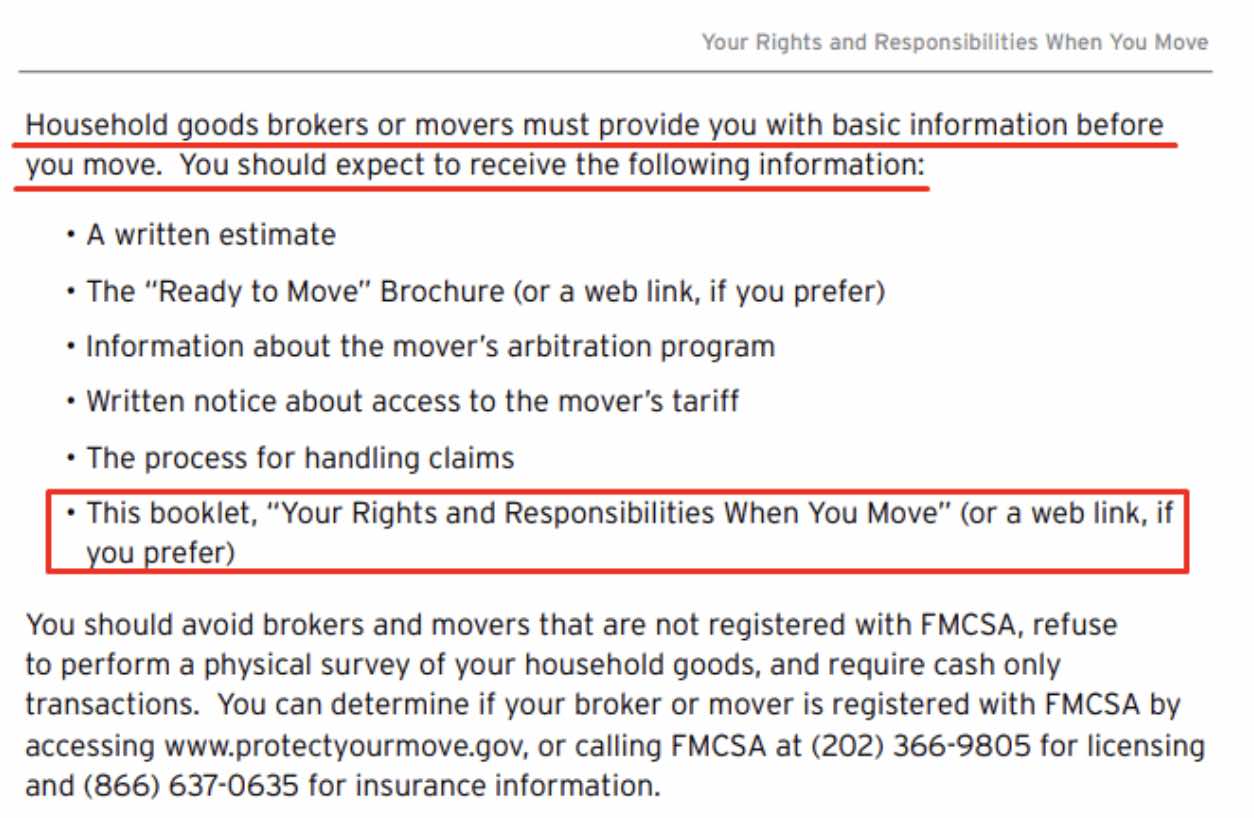
Instead of waiting for your mover, download the booklet and read it before you get estimates. It covers:
- Choosing a mover: What to check before you book. See our guide to finding a reputable moving company.
- Valuation: An in-depth explanation of your coverage options.
- Moving fraud: What to do if a mover holds your belongings hostage or overcharges you.
You can also download the FMCSA’s “Ready to Move” brochure.
7. Driver’s descriptive inventory
You’ll get two inventories during your move, and both matter. The first is the cube sheet from your estimator. The second is the driver’s descriptive inventory, which the driver completes before loading anything onto the truck.
The driver tags each item and box, notes which room it came from, and records any existing damage like scratches, dents, or tears. This moving document is used to judge any damage claims after your move, so check it carefully before you sign. If something does go wrong, here’s how to file a damage claim.
Did you know? Drivers use shorthand codes instead of words to describe damage and where it is on an item. Ask the driver to explain any codes you don’t understand before you sign.
8. Change order
If the driver finds on moving day that you’ve added items or didn’t finish packing, the driver or your moving representative will give you a change order. This moving document confirms that you need more services than originally requested, along with an estimated cost for each one.
If you don’t think a change order is justified, don’t sign it. A mover can’t charge more without your signed agreement to a revised estimate.
9. Freight bill (statement of services)
The freight bill, also called the statement of services, is your final bill. You’ll get it once your shipment has been weighed, all services are tallied, and the truck arrives at your new home.
Expect to pay at delivery. Most movers require payment before unloading, unless you’ve arranged to pay by credit card ahead of time.
10. IRS Form 3903 (military moves only)
Form 3903 is the IRS form for deducting moving expenses, but very few people can use it today. Since 2018, only active-duty members of the Armed Forces who move because of a military order and permanent change of station can deduct moving expenses.
If that’s you, download Form 3903 and its instructions. Our guide to deducting moving expenses has more detail.
Insider’s tip: Donating household goods and clothes to charity before you move may qualify for a tax deduction if you itemize, so ask for a receipt when you drop items off.
FAQs about moving documents
Which moving document is the most important?
The most important moving document is the bill of lading, because it’s your legal contract with the mover. Read it carefully before loading and keep a copy until any claims are settled.
What’s a PBO carton?
A PBO carton is a box marked “packed by owner,” meaning you packed it yourself. PBO cartons may also be labeled CU, for “contents unknown.”
What’s a CP carton?
A CP carton is a “carrier packed” box, meaning the moving company’s crew packed it.
What’s a mover’s tariff?
A mover’s tariff is a published document that lists the services a moving company offers and the rates and rules for each. Learn more about mover’s tariffs.
What’s the 110% rule?
The 110% rule means a mover can’t collect more than 110% of a non-binding estimate at delivery. The mover can bill you for any remaining charges after 30 days.
How do I officially change my address?
To officially change your address, submit a change of address request on the USPS website for a $1.25 identity verification fee. See our full change of address guide.
How do I enroll my kids in a new school?
To enroll your kids in a new school, you’ll usually need official transcripts or report cards, immunization records, and proof of residency in the new district. Check with the district for its exact requirements.
How we chose the best moving companies
The moveBuddha team has spent nearly 10 years evaluating moving companies using a rigorous review system to identify the best moving companies. Our thorough methodology evaluates each moving company's services, cost, customer service, and reputation:
Moving services (35%):
We verify operating authority, insurance, and service scope against FMCSA/SAFER and state databases. We confirm availability via standardized mystery-shopping calls (packing tiers, storage type, specialty handling, delivery windows, valuation), and then review contracts alongside complaint and claims patterns over time.
Customer feedback (28%):
We run structured post-move surveys through our Better Moves Project with verifiable documentation. We emphasize on-time performance, care of goods, and estimates’ accuracy, and we investigate outliers before they influence scores.
Online reviews (7%):
We aggregate ratings across multiple third-party sites to reduce platform bias, analyze overall trends and company response behavior, and discount obvious spam/fake signals such as sudden bursts, duplicate language, and low-history profiles.
State availability (12%):
We confirm USDOT numbers, broker vs. carrier status, and any required state permits, then score a state-by-state service matrix that accounts for coverage gaps, seasonal limits, and lane strength. We award additional credit for documented cross-border or specialty lanes.
Additional services (12%):
We verify whether add-ons are performed in-house or subcontracted, look for crew training/certifications for high-value or oversized items, count only documented offerings (tariffs, photos, written service descriptions) confirmed via mystery shopping, and reward robust pre-move planning (virtual surveys, itemized crating).
Quotes/Payment options (6%):
We test standardized move profiles to assess estimate type (binding, not-to-exceed, non-binding), line-item transparency, and disclosed surcharges, require clear written policies for deposits, refunds, and cancellations, and award points for secure, flexible payment methods and customer portals.
Not what you were looking for?
Check out other categories that can help you find the information you need!